Malthios Kills Tyraz and Destroys the Demon Fortress
The Reincarnated Demon King's Host Just Wants to Live in Peace, But the Hero Won't Leave Him AloneMalthios Kills Tyraz and Destroys the Demon Fortress is the turning-point action in which the former Demon King’s return becomes undeniable and the old demon order is ended in a single sequence of revelation, duel, execution, and destruction. It begins with Theo’s body transformed by Malthios’s power and ends with the Demon Fortress consumed by blue fire, leaving the surviving Hero’s party in a world where the organized demon threat has collapsed and the need for a Hero has been fundamentally questioned.
Causes and Background
The confrontation is rooted in the political and personal history of Algeya. Although Malthios had previously been defeated, remnants of his army remained under the command of the surviving Demon Lords, while the Hero’s party continued defending ordinary people from them. The capital and its palace therefore represented the human institutions that had organized resistance to demons, whereas the Demon Fortress embodied the remaining structure of demonic power. Malthios’s presence in the capital had already provoked violent agitation within him: crossing its walls made him want to destroy it, because the place stood as a monument to his defeat and to the world that had replaced his rule.
Tyraz’s challenge is not merely a battlefield encounter. He is a surviving Demon Lord who seeks the crown and has repeatedly treated Malthios’s apparent death as an opportunity to rise. The struggle also threatens Theo, the human host whose existence makes Malthios’s return possible. Tyraz argues that mortals will hunt and kill Theo once they learn that he carries the Demon King, turning the duel into a contest over whether Malthios can protect the person who has become his host and friend. Malthios answers that he has promised to protect Theo and that his word is binding. The political succession crisis and the intimate host bond thus converge in the same fight.
The Demon King’s Return
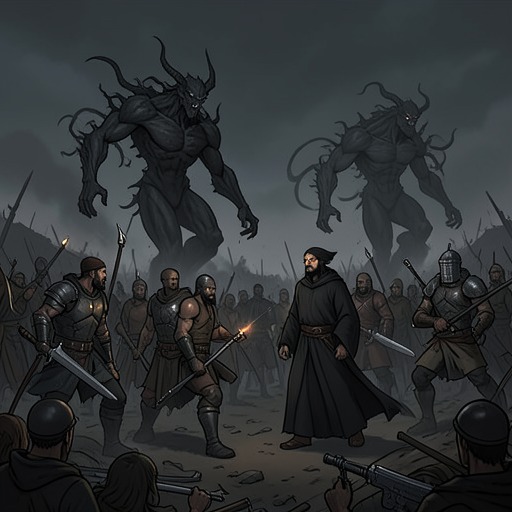
The return is first made visible through a bodily transformation. Power floods Theo for the second time; wings unfold from his shoulders, horns grow from his temples, and his fingertips curl into black claws. The magical surge blasts Tyraz backward. Luc looks up in confusion, unable to tell whether he understands what he is seeing, while the entire courtyard witnesses the identity that Theo has spent the story concealing: Malthios, King of all demons, has returned.
The moment is staged as a public recognition scene rather than a private revelation. The courtyard falls silent, and Tyraz becomes rigid while the demons around him tremble. Malthios takes control because Theo is not ready to face the horror on the Hero’s party’s faces. Yet the transformation does not erase Theo. Malthios explicitly protects the host’s name and identity, insisting that he is Theo rather than a dismissive nickname or merely the Hero’s lover. He describes Theo as brave, selfless, and kind, and calls him both a host and a friend. The return therefore establishes a changed form of Demon Kinghood: Malthios reappears with his old authority and power, but that authority is now inseparable from gratitude toward a human life.
The Duel with Tyraz
Malthios challenges Tyraz to fight for the crown, declaring that he remains the strongest of the demons and the leader of the Pentagram before he was crowned King. He adds that Theo’s power has made him stronger than he was before. Tyraz accepts, expecting the duel to end with Malthios joining the rest of the fallen group. The exchange turns succession into a formal single combat, but it also exposes Tyraz’s miscalculation: he believes Malthios’s human host represents weakness, while Malthios understands the host bond as a source of additional strength.
The combat rises into the air. Tyraz launches himself upward, and Malthios meets him with a single beat of his wings; their swords clash above the courtyard, the ringing steel carrying across the surrounding mountains. Blue fire runs over Malthios’s crossed blades and burns Tyraz when it touches him. Tyraz uses shadows to tangle and restrain his opponent, but Malthios repeatedly summons more fire to consume them. The established opposition between Tyraz’s shadows and Malthios’s blue flame gives the battle a clear physical language: concealment and imitation are answered by exposure and destructive force.
The fight also displays the cooperation of the two souls sharing one body. Whenever Tyraz’s blade cuts Malthios, Theo’s magic rises and bathes the courtyard in green light. Tyraz’s injuries accumulate while Malthios remains in control of the encounter. The narration presents Malthios as having been superior since the first time the two demons met centuries earlier, and his apparent playfulness becomes a deliberate public humiliation of Tyraz before the watching demons. That superiority drives Tyraz toward desperation rather than surrender.
Tyraz then multiplies through the shadows, producing copies whose blades glint in the firelight. Malthios answers by spreading blue flames across his red-feathered wings and spinning into a tornado of fire that burns through the copies. The movement recalls one of Kamil’s favorite techniques, allowing Malthios to carry the memory of a dead companion into the battle. He gathers mana around the sword and cuts through the air; the real Tyraz barely avoids the strike, but the impact destroys a tower of the Demon King’s castle. The duel consequently damages the fortress before the final attack, making the physical collapse of the old order visible even before its ruler falls.
Tyraz vanishes into shadow and then locks blades with Malthios, calling him a human’s pet and claiming that he has become nothing. The insult attempts to redefine the host bond as degradation, but Malthios refuses that interpretation. Tyraz’s threat that mortals will hunt Theo only strengthens the promise Malthios has already made. When Malthios twists his blade free, fire bends around the two combatants, and the sword enters Tyraz’s torso. Malthios reminds him that he once promised to end Tyraz if he tried to take the crown. He then pulls the sword free, and Tyraz falls onto the stone, his grey wings spread before his body dissolves into shadows.
Destruction of the Fortress
Before Tyraz’s body disappears, Malthios takes the crown from his head. The observing demons begin to cheer, recognizing the return of their true King. Yet the crown does not become a simple reward. Malthios studies its black, glasslike points and sees broken fragments of his reflection: black eyes split with red. His remark that the crown had always felt heavier on his head turns victory into an acknowledgment of the burden and corruption attached to rule.
Malthios remembers Kamil, Aym, Foras, and Torq and resolves to carry their memory until the day he and Theo are finally laid to rest. Instead of keeping the crown, he tells Theo to go home and throws it into the air before diving away. This gesture separates victory from restoration. Malthios has defeated the claimant, but he does not revive the former hierarchy for its own sake; the immediate objective becomes returning with Theo and protecting the people trapped in the conflict.
Tyraz’s death also releases the Hero’s party. The magic circle holding them prisoner vanishes, revealing Luc injured while Wicker presses cloth against his side and Veiv and Emi attempt a revival spell. Avery, Bryony, and Khal tense around their weapons when Malthios lands beside them. Rather than attack them, he transports the entire group through shadows back to the forest. The rescue is consequential because Malthios’s return could have ended in vengeance against the Hero’s party, yet his first public act after reclaiming power is to spare and remove them from danger.
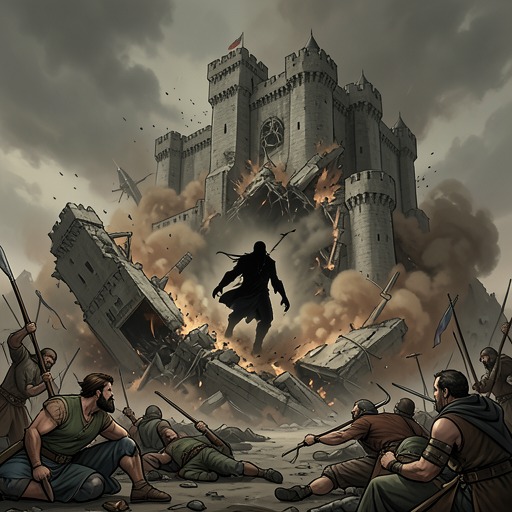
The final destruction follows immediately. Once the shadows clear, the party stands in the forest; a distant explosion then tears through the night, and a column of blue flames rises from the Demon Fortress. Malthios feels a weight leave his shoulders and declares that the demons have ended. The statement is qualified later: lesser demons and demon-created monsters may still remain, but the fortress and all who were there have been destroyed. The action therefore ends organized demonic rule rather than erasing every supernatural threat from Algeya.
Consequences and Significance
The event changes the balance among demons, humans, and the Hero’s party. Tyraz’s death removes the Demon Lord who sought Malthios’s crown, while the fortress’s destruction eliminates the central stronghold of the remaining demon order. The watching demons’ celebration confirms Malthios’s legitimacy, but his refusal to retain the crown denies them a conventional restoration. His authority is revealed, exercised, and then deliberately set aside.
For Theo, the event is both protection and exposure. Malthios’s transformation makes their shared secret visible to the Hero’s party and to the demons present, while Malthios’s defense of Theo’s name publicly redefines the host as a valued person rather than a prison or disposable vessel. This matters because Theo has long believed that no amount of friendship could save him if his nature were discovered. The battle gives that fear a concrete form in Tyraz’s threat, then answers it through Malthios’s promise and action. The protection is not abstract: Malthios chooses Theo over the crown and saves him from the consequences Tyraz predicts.
The event also destabilizes the institution of heroism. After destroying the fortress, Malthios states that there is no longer any need for a Hero, because only scattered lesser demons and demon-created monsters remain. That conclusion is immediately complicated by the political authorities’ continuing insistence that the Hero must kill the Demon King. Luc later declares that it is his duty to kill Malthios, while reserving the choice of when to do so. The fortress’s destruction thus ends one war while opening the moral and legal crisis of what should happen to a Demon King who has become Theo’s protector and has prevented a greater threat.
As a plot structure, the action combines return, rivalry, revenge, ascension, and transformation. Malthios returns in the body of the person who once concealed him, defeats the rival who claims he has fallen, and reaches the height of his old power without repeating his former reign. The decisive reversal is that the supposedly restored Demon King becomes the destroyer of the demonic system he once led. His final movement is away from the crown and toward home, making the climax less a coronation than a release from inherited power and a choice of shared life with Theo.